Uncategorised
- Details
- Written by: Jean Claude de Mauroy
- Category: Uncategorised
- Published:
- Hits: 0 2011
- Details
- Written by: Jean Claude de Mauroy
- Category: Uncategorised
- Published:
- Hits: 0 2122
- Details
- Written by: Jean Claude de Mauroy
- Category: Uncategorised
- Published:
- Hits: 0 1950
Title: LYON METHOD CERTIFICATION COURSE
The Lyon Method for orthopaedic non-surgical treatment of scoliosis and other vertebral deviations.
This course get back to basics of the classic face-to-face training course conducted over 2 and a half days and which is available to you on SSOL. It benefits from all the advantages of digital technology.
COURSE DESCRIPTION
Intended for all those who want to acquire specialized knowledge in the field of vertebral deviation treatment and understand the physiopathological and biomechanical basis of these treatments. Vertebral deviations include: scoliosis, sagittal deviations such as kyphosis due to Scheuermann's disease or not, and spondylolisthesis. Thoracic deviations such as the pectus often associated.
The students should be able to analyse each pathological situation and develop the most appropriate therapeutic management. It is not a question of imitating exercises, but of acquiring the necessary skills to choose the most suitable exercise or construct the better brace.
COURSE FEATURES
16 chapters or Sessions
All skill levels (after Medical or Paramedical Degree)
English Language
Self Assessment during thee course Lyon Method Certification
DATE
This course will begin on September 5th, 2020. The maximum advise time period is 4 months.
PEDAGOGICAL CONTENT
More than 50 videos for a total of 15 hours
About 1500 commented slides in 5 languages
Approximately 250 Self-Assessment questions Quizzes
11 Decision tables and 9 Decision tree
X-ray corner
4th dimension of scoliosis (the story of Lea from 6 to 60 years)
FAQ: How to answer all the questions patients have!
Celebrity Carousel
19 skills and learning outcomes commented
15 digital Workshops with comments
Research module
Forum module
4 Live classroom every month: one for each Section
4 Pratical works every month
FINAL CERTIFICATION
To obtain the certification a Final Knowledge Exam must be successful.
LOCATION
This course is delivered completely online and benefits from a dedicated Learning Management System for certification.
You will need to:
- Follow and complete the Logbook
- Complete a series of short quizzes along the way,
- Complete a final exam held every three month (to book-in at your convenience)
- Submit the Logbook for evidence of competency
Direct link to New York recorded course registration and handout which can be downloaded: https://ssol1.vhx.tv/checkout/lyon-method/purchase
Please contact:
SPECIFIC OBJECTIVES
1. Real integration into a Scoliosis treatment team, i.e. for a PT to be able to carry out the corrective postures allowing a CPO to carry out a brace moulding in a corrected position.
2. Understanding the anatomical, neurophysiological and biomechanical basis of all vertebral deviations, in particular the extra-pyramidal system and 3D correction by coupled movements which are the foundations of the Lyon Method.
3. Acquisition of the necessary basis of radiological interpretation to restore the isostatic balance of the spine in the sagittal plane specific to each patient.
4. Knowledge of the main orthopaedic pathologies associated with vertebral and thoracic deviations.
5. Select the most appropriate exercises and braces using simple tables and decision trees.
6. Be able to answer the patient's usual questions about his or her condition.
7. Information of new technologies to optimize non-surgical treatment
8. Anticipate the evolution thanks to the scientific evidence of the last results of the non surgical treatment.
COURSE MATERIALS AND REQUIREMENTS
We recommend the use of a wide screen placed 10° below the horizontal line of vision. For the X-ray corner, it is useful to have an A4 printer with photo paper and transparent film.
Access codes will be provided at the time of registration. Registration for webinars is optional, but highly recommended.
The course material may be freely used locally and partially reproduced.
COURSE POLICIES
This course is asynchronous, you manage your time according to your possibilities. It is divided into 4 sections. Each section has 4 sessions for a total of 16 sessions. In each session several modules with readings, videos, X-ray corner, decision tables and trees, 4th dimension of scoliosis ...Each session requires a minimum of 2 hours of work. The ideal pace is 1 to 2 hours per day 5 days a week. The use of the forum is highly recommended.
ATTENDANCE
A final exam will be held every 3 months. Participation is conditional to the sending of the self-filled logbook. Even if we have the possibility to do so, connection times are in principle not controlled. The sequence of modules is adapted to a logic of progression and understanding.
ACADEMIC HONESTY
This course is not academic, but the principles are the same.
TECHNOLOGY
There are no technical limits, the most important thing is to work in a quiet environment.
ACCESSIBILITY AND INCLUSION
This course is open to all professionals, as long as they have computer equipment to compensate for any sensory deficit.
GRADING AND ASSESSMENT
Grading scale Final Quiz
90-100% A
80-89% B
70-79% C
60-69% D
<60% Failed
The final quiz consists of 50 items from the entire program and is adapted to the profession. Many items are chosen from those available on the website.
COURSE SCHEDULE AND CALENDAR
It is important to make your own course schedule at the time of registration and to choose a final exam date.
COURSE LEVELS
Registred New York face to face Course is an Introductory Session. SSOL can give the attendance Certificate or Basic Level.
Lyon Method Certification course is a more serious course which gives all the elements to really practice the Lyon Method.
SSOL is working on a further level of coaching to teach the Lyon Method.
EDUCATIONAL UNITS
Sections:This course has 4 sections. Each section is divided in 4 sessions
Section 1: Fundamentals
1.1a History of the Lyon Method
From Middle-age to Pravaz
Lyon Method these last 200 years
PSSE & Lyon method
Extra-pyramidal assessment
It is possible to evaluate the effects of physiotherapy on the extrapyramidal system
1.1 b Very long term results (plaster cast)
The brace with cast significantly reduces the spontaneous evolution of scoliosis in adulthood.
Workshop 1: Balance - The 4 extra-pyramidal tracts
How to stimulate the four tracts of the extra-pryramidal system?
1.2 a Bipedalism? verticalization
Scoliosis is a disease of verticality
Bone changes
Soft Tissue Modifications
Nervous and cerebral changes
Fascias adapt to verticality thanks to tensegrity.
1.2 b Tensegrity, fascias
History, Definitions
Characteristics of a tensegrity system
Tensegrity, posture and plastic deformation
The subcutaneous tissue is a tensegrity system: massages+++.
The brace must ensure creep: by(hypercorrection and total time). The mobility of all segments is essential.
Workshop 2: Tensegrity in standing position
How to restore tensegrity with standing exercises?
1.3 a Scoliogeny of AIS
Definitions
Epidemiology
Genetics | Melatonine (Extra-pyramidal system)
All our progress has not improved the management of Idiopathic Scoliosis.
Why is that ?
Workshop 3: Tensegrity in sitting and quadruped position
How can tensegrity be restored with sitting and quadruped exercises?
1.3 b Chaos theory:
Chaotic & linear scoliosis
Chaos theory
Practical consequences
Linear Scoliosis: Vicious circle
Workshop 4: Tensegrity & Eutonia in decubitus
How to restore tensegrity with eutonia exercises in the supine position?
1.4 Three dimension scoliosis by coupled movements
Movement of a solid
Reference planes
3D terminology
Frontal Plane | Sagittal plane | Horizontal plane
Vertical axis
Solid Geometry
Detorsion
3d Muscular chains
3d by coupled movements
Workshop 5: Tensegrity & abdominal muscles strengthening
How can tensegrity be restored with exercises to strengthen the abdominal muscles in the supine position?
Section 2: Pathology
2.1 Scoliosis on a lifespan
Infantile (early onset) scoliosis
Juvenile scoliosis
Adolescent scoliosis Idiopathic & other etiologies
Scoliosis after risser 2
ASA Adolescent scoliosis in adult
DSS Degenerative De novo scoliosis
ASD Adult Spinal deformity
Scoliosis evolves lifespan with different characteristics, goals and treatments at each age. (Fourth dimension of scoliosis)
Workshop 6: Ergonomy 1
The Lyon method includes ergonomics and teaches the 24 hours of the back.
2.2 a Biomechanics of vertebral deviations
Frontal Statical & Dynamical biomechanics
Sagittal Thoracic biomechanics
Plastic deformation of visco-elastic structures
Therapeutic outcomes (plastic deformation & total time bracing)
Sagittal lumbar biomechanics
Simplified biomechanics in the frontal plane and in the sagittal plane essential for treatment.
Workshop 7: Ergonomy 2
How to lean forward without bending the knees in scoliosis?
2.2 b Lombo-pelvic parameters - Spondylolisthesis
Spondylolisthesis: Anatomy, Epidemiology, Natural history
Clinical assessment
Radiological assessment: Lumbo pelvic parameters & Lumbo-sacral angle
Non surgical orthopaedic treament
Sport & spondylolysis
Bracing results
Very high frequency, a specific lumbo-sacral angle, non-surgical treatment allows the continuation of sport activities.
Workshop 8: Ergonomy 3
Don’t forget Technical aids more specific to scoliosis!
2.3 kyphosis
Kyphosis: Radiological definition
Social background
Epidemiology
Clinical assessment
Radiological parameters & morphotypology
Etiologies & Classification
Main etiology: Scheuermann disease
Non surgical treatment (with history)
Lyon Bracing results
Hyperkyphosis is less well known than scoliosis, but much more painful. Non-surgical orthopaedic treatment is effective.
Workshop 9: Bruno 1 - KYPHOSIS - Assessment & analytic physiotherapy
Bruno is a 15-year-old boy with thoracic kyphosis due to Scheuermann's disease.
2.4 Thoracic deformation & Breathing scoliosis
homo sapiens Rib cage
Pectus excavatum
Recklinghausen & iatrogenic
Pectus carinatum
Scoliosis & breathing
Bracing & pulmonary function
Trunk deformities are not only of the spine, but also of the rib cage deformities. Non-surgical treatment is effective.
Workshop 10: Bruno 2 - Global physiotherapy ½
Do you know the locomotive exercise?
Section 3: Physiotherapy
3.1 Lyon method physiotherapy; Principles
Physiological basis
3d by coupled movements
Vicious mechanism of adult scoliosis
Principles | Phases | Stages | Position | Steps
The Lyon method of Physiotherapy is based on the Physiology of scoliosis on a lifespan.
Workshop 11: Bruno 3 - Global physiotherapy 2/2
Do you know the techniques of the 3 squares?
3.2 Lyon method physiotherapy - 13 Basic exercises
AIS: Clinical assessment
1. Awareness (Tecto-spinal tract)
2. Kyphotization (Longitudinal sensors)
3. Passive concavity mobilization (tensegrity)
4. Facet joints mobilization (Tensegrity all segments must be independent)
5. If ASALIJ: Opening ilio-lumbar angle
6. Stretching of short muscles (hold – relax)
7. Lumbar isostatic sagittal balance and frontal shift
8. Thoracic isostatic kyphosis and frontal bending
9. “Grand porter” self active axial elongation (Geometrical detorsion)
10. Proprioceptive exercises: Swiss balloon, sitting (Vestibulo-spinal tract)
11. Balance exercises: Tilting tray standing (Rubro-spinal tract)
12. Core stabilization (Recoupling extra-p. & pyramidal system)
13. Dynamic beam. All tracts, Statesthesia & kinesthesia
The 13 basic exercises can be used in children with specific indications depending on the stage of treatment. ( Decision table with certification )
Workshop 12: Bruno 4 - Proprioception & Integration
Proprioception and cortical integration in the sagittal function plane.
3.3 (Special PT)
Adult Scoliosis
Workshop 13: Adult scoliosis ASA
Contrary to adolescents, adult scoliosis physiotherapy is rarely practiced in the standing position.
Workshop 14: Adult Scoliosis DDS
The key word in adult scoliosis is pelvic anteversion.
Sport
Schoolbag
Sitting position
Section 4: Bracing
4.1 Lyon brace - New artbrace
Bracing Objectives:
Guiding the growth during the night (all braces)
Nucleus refocusing (hypercorrective nightbrace)
Plastic deformation (Creep total time bracing)
Decrease of asymmetrical load during the day (Composite beam of symmetrical braces)
Remodeling of apical vertebra deformation (in-brace correction >48%)
Bracing innovations
Controlled asymmetry
Very high Rigidity
Solid Geometry: Geometrical & Mechanical Detorsion
4.2 Results:
Risser>2 (soft tissues)
Final results ARTbrace (not only stabilization, but also improvement)
Adult ARTbrace (Corrective bracing)
4.3 (Special CPO) The step by step
Regional Corrective Moulding in 3 steps with 4 columns digitizer
Processing with Specific Software
Manufacturing like all rigid braces
Fitting
Delivery
Checkup
INSTRUCTOR INFORMATION
The course was designed by Jean Claude de Mauroy MD and is the result of more than 40 years of experience in the field of non-surgical orthopaedic treatment of spinal column deviations. Jean Claude de Mauroy is a Medical doctor, certified specialist in Physical and Rehabilitation Medicine, Biomechanics of the musculoskeletal system, Electromyography, Osteopathy and Manual Medicine, Sports Medicine. He is lecturer at the University Lyon 1 and President of the European Spine Centre. He worked from 1972 to 1987 at the Centre des Massues – Lyon (Paediatric Unit), then from 1987 to 2019 at the Clinique du Parc – Lyon (Orthopaedic Medicine). He is co-inventor of the new Lyon ARTbrace.
Orthopaedic Medicine, once a true medical specialty, is currently little taught, while technology has developed and requires special skills.
The Lyon Method is the oldest. Based on the combination of exercises and bracing, it is founded on simple physiological and biomechanical concepts that are much more accessible than other methods.
Contact:
TESTING
Rosemary Marquese (PT) - Australia
Andrea Lebal (PT) - Canada
- Details
- Written by: Jean Claude de Mauroy
- Category: Uncategorised
- Published:
- Hits: 0 1529
Edition 2024 of the book:
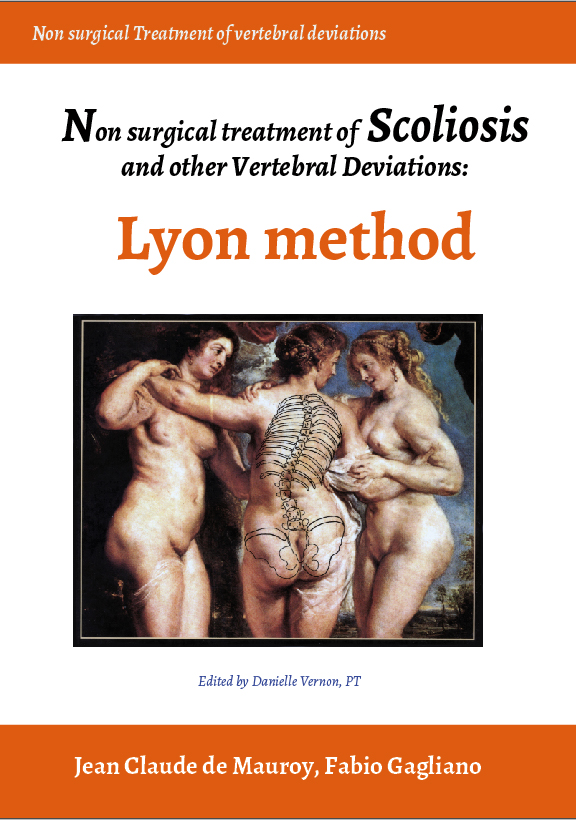
Introduction to Non-Surgical Treatment of Scoliosis and Other Deviations
Understanding Scoliosis, Kyphosis, and Spondylolisthesis
Scoliosis, kyphosis, and spondylolisthesis are common spinal deviations that can significantly impact a person's quality of life. Scoliosis involves a sideways curvature of the spine, kyphosis is characterized by an excessive outward curve of the spine, and spondylolisthesis occurs when a vertebra slips out of place. Understanding these conditions is crucial for effective treatment.
The Importance of Non-Surgical Interventions
Non-surgical interventions are essential for managing spinal deviations, offering a less invasive and often more effective approach compared to surgery. These methods focus on improving posture, reducing pain, and enhancing mobility through targeted exercises and therapies.
Overview of the Lyon Method
The Lyon Method is a comprehensive, non-surgical approach to treating scoliosis and other spinal deviations. Developed through extensive research and clinical practice, this method emphasizes personalized treatment plans and incorporates a variety of techniques to address the unique needs of each patient.
The Lyon Method: A Comprehensive Approach
History and Development of the Lyon Method
The Lyon Method has a rich history rooted in the collaborative efforts of physiotherapists, orthotists, and medical doctors. Over the years, it has evolved to integrate the latest advancements in spinal health and rehabilitation.
Core Principles and Techniques
The core principles of the Lyon Method include patient-centered care, evidence-based practices, and a holistic approach to treatment. Techniques range from manual therapy and corrective exercises to the use of specialized equipment designed to support spinal alignment.
Benefits of the Lyon Method for Patients
Patients who undergo treatment using the Lyon Method often experience significant improvements in pain levels, posture, and overall spinal health. The method's emphasis on non-surgical interventions makes it a preferred choice for many individuals seeking effective and sustainable treatment options.
Detailed Guide to the 21 Chapters of the Book
Chapter Summaries and Key Takeaways
The book is divided into 21 comprehensive chapters, each offering in-depth insights into various aspects of non-surgical treatment for spinal deviations. Key takeaways include practical advice, detailed explanations of techniques, and real-world applications.
How to Use QR Codes for Video Demonstrations
One of the standout features of this book is the inclusion of numerous QR codes that link to video demonstrations. These videos are invaluable for understanding the correct execution of movements and exercises, making the book an indispensable tool for practitioners.
Practical Applications for Physiotherapists, CPOs, and MDs
Physiotherapists (PT), Orthotists (CPOs), and medical doctors will find this book particularly useful. It provides practical applications and detailed guidance on how to implement the Lyon Method in clinical practice, ensuring optimal outcomes for patients.
Case Studies and Real-World Applications
Success Stories from Patients
The book includes inspiring success stories from patients who have benefited from the Lyon Method. These case studies highlight the method's effectiveness and provide motivation for both practitioners and patients.
Clinical Evidence Supporting the Lyon Method
Clinical evidence supporting the Lyon Method is thoroughly documented in the book. This evidence underscores the method's efficacy and reinforces its status as a leading non-surgical treatment for spinal deviations.
Essential Tools and Resources for Treating Spinal Deviations
Must-Have Equipment and Tools
The book outlines essential equipment and tools needed for effective treatment, including specialized braces, exercise equipment, and manual therapy tools. These resources are crucial for implementing the Lyon Method successfully.
Recommended Exercises and Techniques
A variety of recommended exercises and techniques are detailed in the book, providing practitioners with a comprehensive toolkit for treating scoliosis, kyphosis, and spondylolisthesis. These exercises are designed to improve spinal alignment, reduce pain, and enhance overall mobility.
Additional Resources and Further Reading
For those interested in furthering their knowledge, the book includes a list of additional resources and suggested readings. These materials offer deeper insights into spinal health and non-surgical treatment methods, making them valuable for continued learning and professional development.
This book is an indispensable resource for anyone involved in the treatment of spinal deviations. Whether you are a physiotherapist, CPO, or medical doctor, the comprehensive guidance and practical applications provided in this book will enhance your practice and improve patient outcomes.